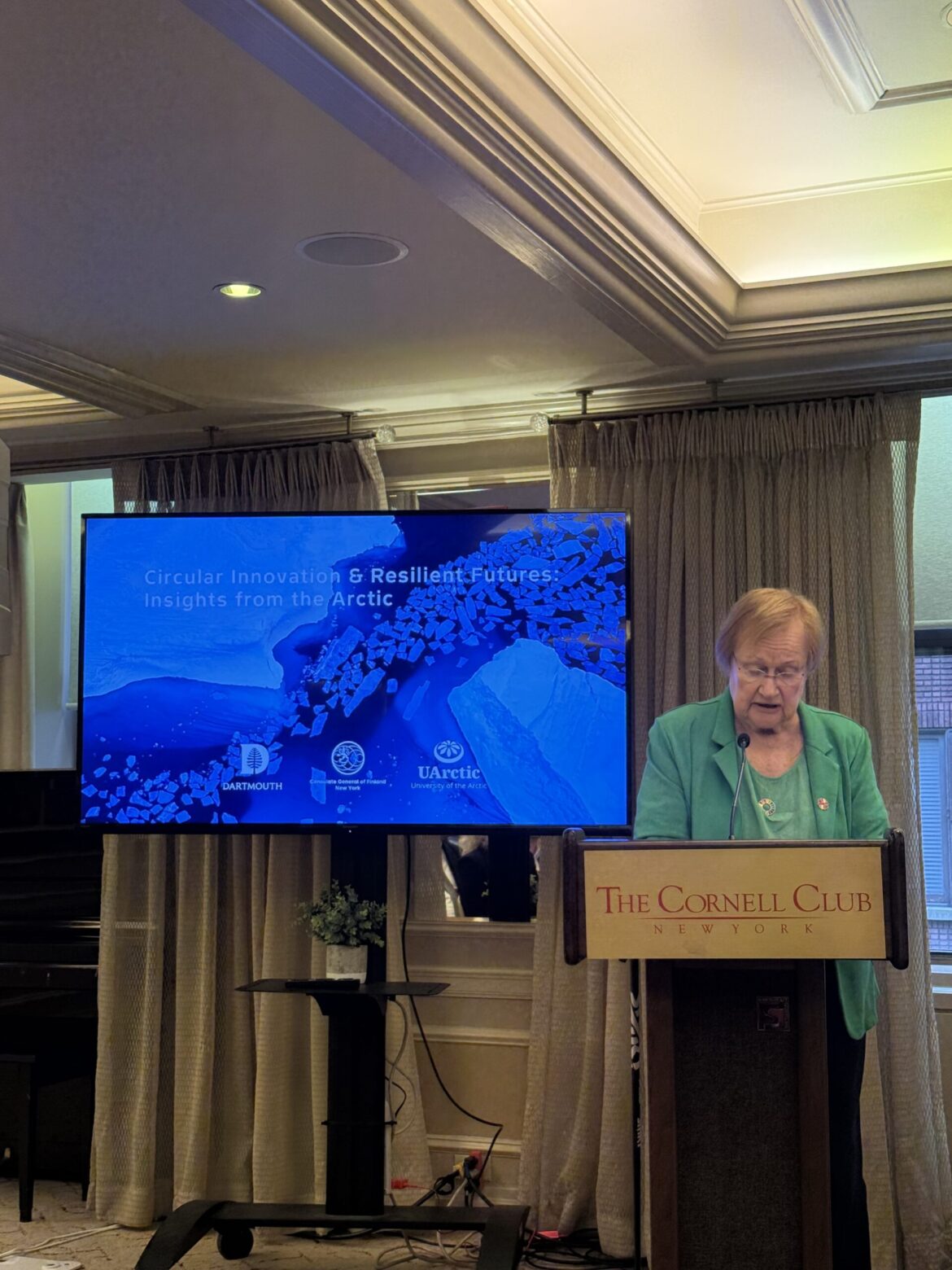
A Recipe for Arctic Resilience: Cooperation, Inclusion and Innovation. Keynote address by H.E. Ms. Tarja Halonen, Former President of Finland at Circular Innovation & Resilient Futures event organized by Consulate General of Finland, Dartmouth College and UArctic, 23 September 2026.
Distinguished guests,
Colleagues, Dear friends,
Ladies and Gentlemen,
Let me begin by thanking the Consulate General of Finland in New York, Dartmouth College and UArctic for bringing us together to discuss Arctic resilience – at a moment when the Arctic is going through a time of rapid change. I understand you have had a fruitful discussion on resilience and circular economy.
When we talk about the Arctic today, we often talk about the shrinking ice cap, new shipping routes, critical minerals and – quite naturally – about climate change.
All these matter.
But first and foremost, the Arctic is home.
It is home to peoples and communities that have lived there for thousands of years. The Arctic population – and foremost Indigenous Peoples – have learned to survive and adapt under demanding conditions. For that reason, the Arctic has much to teach the rest of the world about resilience.
Today, I would like to reflect on three elements of what I call a recipe for Arctic resilience: cooperation, inclusion and innovation.
* * * * *
Dear friends,
Let me start with a few words on Arctic cooperation.
For a long time, the Arctic was often presented as an exceptional region in international relations. Even when tensions existed elsewhere, Arctic states were generally able to work together in a constructive manner. Through dialogue, scientific cooperation and practical problem-solving, the region built a reputation for stability and predictability.
Today, the Arctic has moved from the margins to the center of international politics.
The reasons are evident. Climate change is opening new maritime routes. The strategic significance of critical minerals is obvious. Security, energy policy and economic competition have become deeply intertwined in the High North.
At the same time, the geopolitical climate in the Arctic has changed. Arctic cooperation is turning into Arctic competition. It is worth noting, however, that international cooperation in Antarctica has continued to function remarkably well.
Russia’s war against Ukraine has profoundly affected the atmosphere for cooperation. Confidence and trust have diminished. Security concerns are more visible, both in Europe and North America. The Arctic is increasingly viewed through a strategic lens.
For Europe, the Arctic is simultaneously a question of security, sustainability and economic opportunity. At the same time, The European Union is seeking to preserve the Arctic as a region of peace, stability and rules-based cooperation.
The United States and Russia approach the Arctic from their own strategic perspectives. For Russia, the Arctic occupies an important place in national security policy, economic development and national identity. For the United States, the Arctic has become a critical arena for national security, power projection, and resource management. The US approach regarding Greenland has taken even Europe by surprise.
It is however encouraging that Denmark, Greenland and the United States have sought a common understanding regarding the future of Greenland. I hope the agreement will strengthen the stability and security in the Arctic and while respecting the sovereignty of Denmark – and Greenland’s right to self-government.
Let us be clear. The future of Greenland can only be decided by the people of Greenland themselves. As a long-standing supporter of the United Nations, I firmly believe that international law, respect for sovereignty and the principle of self-determination are not obstacles to cooperation. They are the foundation for international cooperation.
********
While the priorities may differ, I believe all Arctic states ultimately share a common interest in avoiding instability. The Arctic should be preserved as a region where competition does not replace cooperation.
From this point of view, it is worth remembering that Arctic cooperation has also produced important results over the years. Scientific cooperation, environmental research and practical collaboration have raised awareness of a rapidly changing Arctic. Today practical cooperation continues through universities, research institutions, local communities and businesses. These networks help maintain dialogue and build resilience across borders.
Last week, European leaders gathered in Rovaniemi to discuss the future of the Arctic. They sent an important message. Europe’s response to growing geopolitical competition in the Arctic should be greater engagement, stronger resilience and closer cooperation among like-minded partners. At the same time, they reaffirmed that the Arctic must remain a region where peace, stability, sustainable development and respect for international law guide their actions.
Amid all these discussions about strategy, security and geopolitics, we should remember something very simple.
The Arctic is also home.
It is home to peoples and communities who have lived there for generations and, in many cases, for millennia. Their wellbeing, their cultures and their future must remain at the center of our thinking.
Any lasting vision for the Arctic must recognize it is a living region, populated by people whose future must remain at the forefront of our attention.
And that leads naturally to my second point, which is that resilience begins with people.
* * * * *
Dear friends,
The Arctic is, and has always been, a human region.
Long before outsiders discovered the Arctic region, Indigenous Peoples had developed sophisticated knowledge systems that enabled them to live sustainably in some of the most demanding environments on Earth.
Today, Indigenous Knowledge is increasingly recognized as an essential complement to modern science.
Indigenous Knowledge contributes to climate adaptation. It strengthens biodiversity monitoring. It supports safer navigation and maritime operations in Arctic waters. It provides locally grounded insights that cannot be captured through satellites, models or remote sensing technologies alone.
When modern science and Indigenous Knowledge work together, both become stronger.
But resilience is not only about knowledge.
It is also about inclusion.
Gender equality is one of the key measures of a community’s resilience.
In the Arctic, progress has been made, but challenges remain.
Indigenous Peoples and local communities continue to face barriers to full participation and, in some communities, unacceptable levels of violence and insecurity. At the same time, many Arctic communities are experiencing profound social and economic transitions. Traditional livelihoods are changing, and young people, both women and men, often face difficult questions about identity, opportunity and belonging.
Yet there are also many reasons for hope.
Across the Arctic, Indigenous women are assuming increasingly visible roles as political leaders, entrepreneurs, researchers and advocates for their communities. Their voices help shaping local decision-making as well as international discussions on climate change, sustainable development and Indigenous rights.
I am also encouraged by the cultural vitality that we see across the Arctic today. Many Indigenous communities are working to preserve and revitalize their languages, traditions and ways of life. They are demonstrating that cultural identity and modernization are not opposites. They can support one another.
Strong communities are built on respect, participation and a sense of shared responsibility. These are values that have long been present in many Indigenous cultures. At a time when societies everywhere are searching for ways to strengthen resilience, there is much we can learn from them.
The lesson is clear. Gender equality is about both fairness and human rights. It is also about resilience. Communities are strongest when everyone can contribute their knowledge, talents and leadership to the common good.
For Arctic communities, the future depends on exactly that: ensuring that every member of society has both the opportunity and the voice to contribute to the future of their people and their homeland.
Last month, I had the opportunity to participate in the conference of UN Convention to Combat Desertification in Mongolia. The country shares many similarities with the Arctic region. One of the messages I took away from those discussions was the profound interconnection between land, ocean and climate. I have sometimes described this relationship as a holy trinity.
Few places demonstrate that connection more clearly than the Arctic.
As temperatures rise at a rate far above the global average, changes in climate affect the land, the sea, ecosystems, traditional livelihoods and local communities simultaneously. None of these challenges can be addressed in isolation.
The message from Mongolia was both simple and powerful: when women have stronger rights, greater access to land and a meaningful voice in managing natural resources, entire communities become more resilient.
Around the world, women are often the stewards of land, water and food systems. Their knowledge and leadership frequently determine whether communities can adapt successfully to environmental change.
The same lesson applies in the Arctic.
Equality is not only a matter of justice.
It is also a matter of practical effectiveness.
And if we want resilient communities, we must also create resilient economic systems.
This brings me to my third and final point that concerns resilience itself.
* * * * *
Dear friends,
In Finland, resilience has never meant simply enduring difficult circumstances. It has meant the ability to learn, adapt and renew ourselves when the world around us changes.
As a small country in the North, we have learned that our greatest resource has been the knowledge, skills and creativity of our people.
This understanding is deeply rooted in our history. Earlier generations learned to live within ecological limits. They repaired, reused and valued materials because resources were scarce and nothing could be taken for granted. What we today call the circular economy was earlier just simply common sense.
Ten years ago, Finland became the first country in the world to adopt a national Road Map to a Circular Economy.
The roadmap was important in itself and the spirit behind it. It reflected the conviction that economic development, social responsibility and environmental sustainability are not competing objectives. They must advance together.
This required cooperation.
Government, businesses, researchers and civil society organizations came together around a shared understanding that long-term prosperity can only be built on the sustainable use of resources.
I believe this remains one of Finland’s strengths. We have developed a tradition of bringing different actors to the same table and seeking solutions together. In times of uncertainty, this capacity for dialogue is perhaps more valuable than ever.
We see good examples of this approach represented here today.
Together, they remind us of a simple lesson.
Only together can we solve the challenges of today.
Public authorities can provide direction. Researchers can provide knowledge. Businesses can provide innovation and investment. Civil society can help ensure that progress is fair and inclusive.
Resilience grows when these different strengths are combined.
This lesson is particularly relevant for the Arctic.
For generations, Arctic communities have had to cope with uncertainty and change. They understand that resilience is not simply the ability to endure shocks. It is the ability to adapt learn, adapt and emerge stronger.
This experience has value far beyond the Arctic.
The challenges we see in the North today, whether it is climate change, pressures on natural resources or economic transformation – they are increasingly the same challenges societies around the world are confronted with.
That is why the Arctic should be seen as a source of knowledge, innovation and practical solutions.
Across the Arctic, researchers, Indigenous Peoples and local communities and businesses are developing new ways to strengthen sustainability while creating opportunities for future generations.
And perhaps that is the most important message I would like to leave with you today.
The Arctic is not only a region where global challenges appear first.
It is also a region where the world can find inspiration for solutions.
* * * * *
Ladies and gentlemen,
If I were to summarize the recipe for Arctic resilience in three ingredients, they would be these:
First, cooperation – even when geopolitical circumstances are difficult.
Second, inclusion – ensuring that Indigenous Peoples, local communities, women and men are full participants in shaping the future.
And third, innovation – transforming knowledge, including Indigenous Knowledge, into practical solutions through partnership between governments, researchers, businesses and civil society.
Thank you.